RFP vs. RFQ vs. RFI: Which One Do You Actually Need?
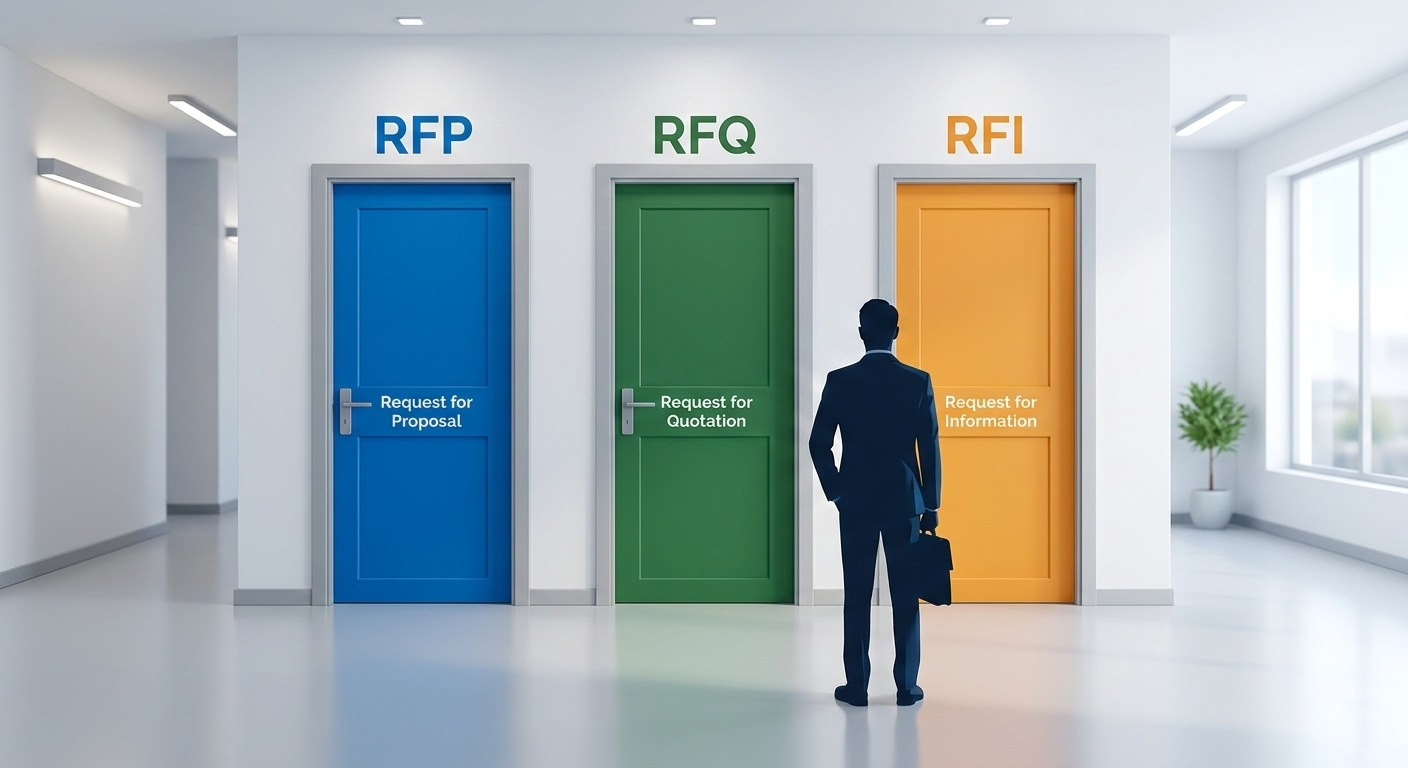
RFP vs. RFQ vs. RFI: Which One Do You Actually Need?
If you've ever Googled "how to solicit vendor bids," you've probably encountered these three acronyms and wondered whether the distinction actually matters.
It does. Using the wrong solicitation type wastes time, confuses vendors, and can produce responses that don't give you what you need to make a decision.
The good news: choosing the right one is simpler than most procurement guides make it seem. Let's cut through the jargon and help you pick the right tool for your situation.
The Quick Answer
RFI (Request for Information): "We're exploring our options. Tell us what you offer."
Use when you're early in the process and don't know enough to define what you need.
RFQ (Request for Quote): "We know exactly what we need. Give us your price."
Use when the scope is fully defined and the decision comes down to price and basic qualifications.
RFP (Request for Proposal): "Here's our project. Show us how you'd approach it and what it would cost."
Use when you need to evaluate the whole vendor—approach, qualifications, experience, and price.
That's it. The rest of this article explains the nuance, but if you're in a hurry, those three sentences will steer you right 90% of the time.
RFI: The Discovery Phase
An RFI is a research tool, not a buying tool. You're not asking vendors to commit to pricing or propose a specific solution. You're asking them to share information about their capabilities so you can figure out what's even possible.
When to use an RFI:
You're entering a new category of spending and don't know the market. For example, your HOA has never contracted security services before, and you want to understand what's available—armed vs. unarmed, mobile patrol vs. fixed post, technology-assisted vs. traditional—before you define your requirements.
You're considering a major change and want to understand options. Maybe your organization currently handles janitorial services in-house and you're considering outsourcing. An RFI helps you understand what vendors offer, what it typically costs, and what the transition looks like.
You want to build a qualified vendor list for future solicitations. An RFI can help you identify which companies in your market provide the services you need, what their capabilities are, and who you'd want to invite to a future RFP or RFQ.
What an RFI typically asks:
- Company overview and history
- Services offered and service area
- Typical client size and type
- General pricing structure (ranges, not firm quotes)
- Relevant certifications and credentials
- References from similar organizations
What an RFI does NOT do:
An RFI doesn't commit vendors to any pricing. It doesn't create a binding obligation for either party. And it shouldn't be used as a backdoor to getting free proposals—vendors will see through that immediately and decline to participate.
Common RFI mistake: Using an RFI when you actually know what you need. If you can define your scope of work in specific terms, skip the RFI and go straight to an RFP or RFQ. Sending an RFI followed by an RFP for the same project adds weeks to your timeline and makes vendors do the same work twice.
RFQ: When Price Is the Primary Decision Factor
An RFQ works when you've already defined exactly what you need and the main variable is cost. The scope is clear, the specifications are set, and you're essentially asking vendors to fill in the price column.
When to use an RFQ:
You're buying a commodity or standardized service. If every qualified vendor will deliver essentially the same output—same materials, same specifications, same result—the decision is primarily about price. Examples: bulk supply purchases, standardized equipment, simple service contracts with well-defined outputs.
You're rebidding an existing contract with a known scope. If you've had a landscaping contract for three years and the scope hasn't changed, you don't need vendors to propose their approach. You need them to price the work you've already defined.
Your organization requires the lowest price from qualified bidders. Some municipalities and government-adjacent organizations have procurement policies that mandate lowest-qualified-bidder selection. An RFQ is the right vehicle for this requirement.
What an RFQ typically includes:
- Detailed specifications or scope of work
- Standardized pricing format (line-item pricing table)
- Vendor qualification requirements
- Timeline and delivery expectations
- Terms and conditions
What an RFQ does NOT evaluate:
An RFQ doesn't ask vendors to demonstrate their approach, methodology, or creative thinking. It assumes all qualified bidders will deliver the same result, so the only variable is cost.
Common RFQ mistake: Using an RFQ for services where quality varies significantly between providers. Landscaping, construction, IT services, consulting—these are areas where vendor approach, experience, and capability matter as much as price. An RFQ forces you to select the cheapest option even when a slightly more expensive vendor might deliver dramatically better results.
RFP: The Comprehensive Evaluation
An RFP is the most thorough solicitation type. It asks vendors to demonstrate not just what they'll charge, but how they'll approach the work, what qualifications they bring, and why they're the right choice for your project.
When to use an RFP:
The decision involves more than price. Any time you need to weigh quality, experience, approach, or capability alongside cost, an RFP gives you the structured framework to evaluate those factors.
The project has complexity or risk. Complex projects benefit from seeing how different vendors would approach the work. Their methodology, project management approach, and risk mitigation strategies tell you things that a price quote never will.
You need to defend the decision to stakeholders. RFPs with defined evaluation criteria and weighted scoring produce documented, defensible decisions. When a board member asks "why did you choose vendor B over the cheaper vendor A?" you can point to the scoring breakdown.
Multiple factors could differentiate vendors. If the "best" vendor might not be the cheapest vendor, you need an RFP to evaluate the full picture.
What an RFP typically includes:
- Project background and organizational context
- Detailed scope of work
- Evaluation criteria with percentage weights
- Required qualifications and certifications
- Standardized pricing format
- Submission instructions and timeline
- Terms and conditions
What makes an RFP different from an RFQ:
The key distinction is the "proposal" part. Vendors aren't just quoting a price—they're proposing a solution. They explain their approach, present their qualifications, provide references, and make a case for why they're the right choice. This gives you information that pure pricing never reveals.
Common RFP mistake: Using an RFP for simple purchases where price is genuinely the only factor. If you're ordering 500 folding chairs and any supplier's product will be identical, an RFP adds unnecessary complexity. Use an RFQ.
Decision Framework: A Practical Guide
Still not sure which to use? Walk through these questions:
Do you know what you need?
- No → Start with an RFI to explore options, then follow up with an RFP or RFQ.
- Yes → Continue to the next question.
Is the scope fully defined with specific quantities and specifications?
- Not yet → Use an RFP so vendors can help shape the approach.
- Yes, precisely → Continue to the next question.
Does the decision come down to price alone?
- Yes, all qualified vendors deliver the same output → Use an RFQ.
- No, quality and approach matter → Use an RFP.
Do you need to present the decision to a board or committee?
- Yes → Use an RFP. The evaluation framework and documentation make board presentations significantly easier.
- No → Either RFP or RFQ works depending on the answers above.
Real-World Examples
Example 1: Selecting a landscaping vendor for an HOA
You manage a 200-unit community and need to hire a new landscaping company. The scope is established (you know what needs to be maintained), but you want to evaluate vendors on more than just price—experience with similar communities, crew size, response time for issues, and approach to seasonal transitions all matter.
Best choice: RFP. The evaluation requires comparing qualitative factors alongside pricing.
Example 2: Purchasing office furniture for a nonprofit
Your nonprofit is moving to a new office and needs 15 desks, 15 chairs, and 3 conference tables. You've selected specific models from a catalog.
Best choice: RFQ. The products are standardized. You just need the best price from a reliable supplier.
Example 3: Exploring cloud storage options for a school
Your private school currently uses local file servers and wants to explore cloud storage solutions. You're not sure what's available, what it costs, or what the migration would involve.
Best choice: RFI first, then an RFP once you understand the options and can define your requirements.
Example 4: Rebidding an existing snow removal contract
Your current snow removal contract expires in October. The scope hasn't changed—same parking lots, same sidewalks, same trigger depths. You just want competitive pricing.
Best choice: RFQ. The scope is fully defined. You need pricing from qualified vendors.
Example 5: Hiring an accounting firm for annual audit
Your nonprofit needs to select an auditing firm. Price matters, but so does the firm's experience with nonprofit accounting, their approach to the audit process, and their communication style.
Best choice: RFP. Auditing is a professional service where vendor quality varies significantly.
Can You Combine Them?
Yes, and many organizations do. A common approach is to start with a short RFI to identify qualified vendors and understand the market, then issue a formal RFP to a shortlisted group.
This two-phase approach works well when you're entering a new spending category, evaluating a large number of potential vendors (the RFI narrows the field), or dealing with a technically complex project where you need vendor input before defining requirements.
The downside is time. A two-phase process adds 2–4 weeks compared to going straight to an RFP. For routine procurements in familiar categories, skip the RFI and go directly to the appropriate solicitation.
How Bid Grid Fits In
Bid Grid is designed primarily for the RFP process—the most common and most time-consuming solicitation type for small organizations. The platform handles RFP creation (with guided templates for common categories), vendor submission (through a no-login portal), and automated comparison and scoring.
If your situation calls for an RFQ, Bid Grid's RFP templates can be simplified to focus primarily on pricing. And if you're at the RFI stage, the platform can help you organize responses, though a simple email request often suffices for information gathering.
Create your first RFP free and see how a structured process simplifies the most complex part of procurement.
Know what you need? Start your RFP today. Sign up free →
Frequently Asked Questions
Can I send an RFQ and then switch to an RFP?
You can, but it confuses vendors and signals that your process isn't well-planned. If you're unsure which to use, default to an RFP—it captures everything an RFQ would, plus the qualitative evaluation.
Do vendors prefer RFPs or RFQs?
Vendors generally prefer whichever matches the actual decision being made. They dislike RFPs for commodity purchases (unnecessary work) and RFQs for complex services (reduces them to their price tag). Match the solicitation to the situation.
How long should each solicitation type take?
RFIs: 2–3 weeks for vendor response, 1 week for your review. RFQs: 1–2 weeks for vendor response, a few days for comparison. RFPs: 2–4 weeks for vendor response, 1–2 weeks for evaluation. These are guidelines—adjust based on project complexity.
Is an RFP legally binding?
No. An RFP is a solicitation, not a contract. Neither party has a binding obligation until a contract is signed. However, some jurisdictions have requirements around how RFPs are conducted, particularly for public entities. Check your local rules if you're a government or quasi-government organization.